


 02-Oct-2026
Building a commercial streaming app across the United Arab Emirates and the broader Middle East has evolved into a strategic necessity for broadcasters, telecommunications operators, and sports rights holders. With near-ubiquitous 5G connectivity, high smartphone penetration, and shifting viewer habits across Dubai, Abu Dhabi, Sharjah, and regional hubs, launching an over-the-top media platform requires a clear understanding of capital expenditure (CapEx) and operational expenditure (OpEx).
Navigating the OTT development cost 2026 landscape demands evaluating several interconnected cost variables: cloud infrastructure scaling, multi-device app packaging, dynamic ad insertion (DAI), multi-DRM security, and localized payment integrations with telecom providers like e& and du. Partnering with an experienced OTT platform development company UAE enables media enterprises to balance technical architecture with clear revenue projections.
This comprehensive guide breaks down enterprise costs, architectural decisions, hidden operational fees, and investment strategies for streaming projects across the UAE and GCC region in 2026.
Executive Summary: What Drives OTT Development Cost 2026?
Calculating an accurate budget for an enterprise video service goes far beyond initial software coding. Modern streaming platforms operate as distributed cloud systems that incur ongoing bandwidth, transcoding, licensing, and security costs as viewer traffic scales.
+-------------------------------------------------------------------------------+
|                       Core Cost Components for UAE Platforms                  |
+---------------------------------------+---------------------------------------+
|        Capital Expenditure (CapEx)    |      Operational Expenditure (OpEx)   |
|  • Native Mobile & Smart TV Apps      |  • Multi-CDN Egress & Transcoding     |
|  • UI/UX Design & Custom Player Engine |  • Multi-DRM License Token Fees       |
|  • Payment Gateway & DCB Integrations |  • Video CMS Cloud Hosting & Maintenance|
+---------------------------------------+---------------------------------------+
Strategic Regional Budget Drivers
- Multi-Device Target Ecosystems: Launching across iOS, Android, Apple TV, Android TV, Samsung Tizen, and LG WebOS increases initial frontend development costs.
- Localization & Payment Integrations: Support for Arabic/English right-to-left (RTL) interfaces, multi-currency checkouts, and Direct Carrier Billing (DCB) requires custom middleware.
- Studio-Grade Content Security: Content owners licensing high-value live sports or Ramadan series must budget for multi-DRM license tokens and dynamic forensic watermarking.
Establishing an accurate budget starts with a well-researched OTT Business Plan that aligns technical expenditure with subscriber acquisition and lifetime value (LTV).
Tiered Cost Estimates: Startup MVPs to Enterprise Platforms
To help enterprise leaders plan budgets, the following table outlines typical cost ranges, development timelines, and feature scopes for streaming deployments in 2026.
| Platform Tier | Scope & Target Audience | Estimated CapEx Budget (USD) | Estimated Timeline |
| Basic MVP / Niche VOD | Web platform + iOS/Android apps, basic SVOD, standard VOD catalog | $25,000 – $45,000 | 2 – 3 Months |
| Mid-Market Streaming Service | Mobile + Smart TV apps (Tizen/WebOS), live channel ingestion, basic DRM, AVOD/SVOD hybrid | $50,000 – $90,000 | 3 – 5 Months |
| Enterprise Broadcast / Sports | Full multi-device app matrix, low-latency live streaming, multi-DRM, SSAI ad integration, DCB billing | $100,000 – $250,000+ | 6 – 10 Months |
| Custom Telecom / Multi-Tenant | Scalable microservices, multi-region CDN routing, custom analytics, white-label tenant management | $250,000 – $500,000+ | 9 – 14 Months |
Key Technical Cost Drivers in Streaming Architecture
The total OTT development cost 2026 is determined by four primary architectural pillars:
1. Ingestion, Transcoding, and Packaging Pipelines
Live streams and VOD source files must be encoded into adaptive bitrate (ABR) profiles (H.264, H.265/HEVC, AV1) and dynamically packaged into HLS and MPEG-DASH formats. Dynamic packaging eliminates static file duplicates, reducing storage overhead while ensuring compatibility across all screen sizes.
2. Media Orchestration & Metadata Governance
Managing expansive media catalogs requires a flexible orchestration engine. Implementing dedicated Video Content Management Systems ensures editorial teams can curate content schedules, localized metadata, and multi-language audio tracks. Utilizing an enterprise-grade Video CMS provides the central API layer required to feed client applications reliably.
3. Multi-Device Native App Matrices
Developing separate native codebases for iOS (Swift), Android (Kotlin), Samsung Tizen, LG WebOS, and Apple TV accounts for 40% to 50% of initial software development costs. Cross-platform frameworks can lower upfront costs but may require custom player optimizations for Smart TV platforms.
Architecture Diagram & Workflow Overhead
The following architecture diagram illustrates how media files move from source ingestion through packaging, security layers, and multi-CDN distribution down to client applications, along with their associated cost drivers.
+---------------------------------------------------------------------------------+
|               Enterprise Video Pipeline & Cost Allocation Map                   |
+---------------------------------------------------------------------------------+
|                                                                                 |
|  [ Live / VOD Ingestion ] ---------> [ Cloud Transcoding (Per Minute Fee) ]     |
|                                                     |                           |
|                                                     v                           |
|                                     [ Just-In-Time Dynamic Packaging ]          |
|                                                     |                           |
|                    +--------------------------------+--------------------+      |
|                    |                                |                    |      |
|                    v                                v                    v      |
|         ( Multi-DRM Gateway )               ( SSAI Ad Server )    ( Video CMS ) |
|         [$0.002-$0.008 / License]           [eCPM Rev Share]      [Monthly SaaS]|
|                    |                                |                    |      |
|                    +--------------------------------+--------------------+      |
|                                                     |                           |
|                                                     v                           |
|                                     [ Multi-CDN Switching Layer ]               |
|                                     [ Bandwidth Egress $ / GB ]                 |
|                                                     |                           |
|         +-------------------------------------------+------------------------+  |
|         |                                           |                        |  |
|         v                                           v                        v  |
|  [ iOS / Apple TV App ]                     [ Android / Smart TV ]    [ Web ]   |
|  [ Custom CapEx Build ]                     [ Custom CapEx Build ]    [ Build ] |
|                                                                                 |
+---------------------------------------------------------------------------------+
Build vs. Buy Financial Analysis: Custom Microservices vs. Modular Platforms
Choosing between custom microservices engineering and deploying a modular platform engine is a major financial decision for streaming providers.
| Cost & Operational Dimension | Custom Microservices Build | Modular / White-Label Platform |
| Initial Upfront CapEx | High ($150,000 – $400,000+) | Moderate ($20,000 – $60,000) |
| Time-to-Market | 9 to 18 Months | 2 to 4 Months |
| In-House Engineering Team | Requires dedicated DevOps & Player Engineers | Minimal; managed by platform vendor |
| Annual Maintenance Overhead | 15% – 20% of initial build cost annually | Included in monthly SaaS / OpEx agreement |
| Feature Customization | 100% bespoke flexibility | High via configurable design frameworks |
| Risk of Cost Overruns | High due to shifting technical scope | Low; predictable pricing tiers |
Deploying established White Label OTT Solutions offers a proven middle ground. It provides pre-built client applications for web, mobile, and Smart TVs while preserving open APIs for custom backend integrations. Organizations evaluating options to create your own OTT platform can significantly reduce time-to-market and CapEx risk by leveraging modular engines.
Security Stack Costs: Multi-DRM, Watermarking, and Geo-Blocking
Protecting high-value media rights against regional digital piracy requires an enterprise security stack. Single-DRM configurations are insufficient because modern web browsers, mobile operating systems, and Smart TVs enforce distinct decryption standards.
                      +-----------------------------------+
                      |   Multi-DRM Licensing Gateway     |
                      +-----------------+-----------------+
                                        |
        +-------------------------------+-------------------------------+
        |                               |                               |
        v                               v                               v
+------------------+           +------------------+           +------------------+
| Google Widevine  |           |  Apple FairPlay  |           | Microsoft        |
| (Android, Chrome)|           |  (iOS, Safari,   |           | PlayReady        |
|                  |           |   Apple TV)      |           | (Smart TVs, Edge)|
+------------------+           +------------------+           +------------------+
1. Studio-Grade Multi-DRM Licensing
Securing digital assets requires implementing three major encryption engines simultaneously:
- Google Widevine (L1/L3): Protects Android smartphones, Chrome browsers, and Android TV units.
- Apple FairPlay Streaming: Protects HLS streams delivered to iOS, Safari, and Apple TV hardware.
- Microsoft PlayReady: Secures DASH streams on Smart TV ecosystems (Samsung Tizen, LG WebOS) and Windows devices.
Deploying comprehensive Digital Rights Management involves license server integration fees and usage-based token costs (typically $0.002 to $0.008 per license request). Using dedicated Digital Rights Management Software simplifies license key exchanges and prevents screen recording. Platforms upgrading legacy setups can execute an OTT DRM Replacement strategy to maintain uninterrupted playback for active subscribers. Learn how to structure a multi-DRM pipeline in our detailed guide on Multi DRM.
2. Forensic Watermarking & Geo-Blocking Infrastructure
- IP Intelligence & Geo-Fencing: Licensing agreements mandate blocking viewers outside licensed territories. Integrating IP intelligence engines blocks traffic originating from VPNs and open proxies across Dubai, Abu Dhabi, and international regions.
- Session Watermarking: Embeds invisible viewer IDs into the video buffer, allowing security teams to identify the source of leaked streams within minutes.
Ongoing Operational Expenditure (OpEx) & Hosting Cost Factors
Beyond initial software development, platform owners must budget for variable cloud infrastructure fees.
1. Cloud Storage & CDN Bandwidth Egress
- VOD Storage: Cloud storage for a 1,000-hour HD library averages $200 – $500/month.
- CDN Delivery Costs: Bandwidth egress in the Middle East ranges from $0.03 to $0.08 per GB. Streaming 100,000 hours of HD video monthly equates to roughly 150,000 GB, translating to $4,500 – $9,000 in monthly CDN expense.
2. Live Transcoding & SSAI Ad Insertion
- Live Transcoding: Cloud encoding fees range from $0.03 to $0.10 per stream minute depending on input resolution and frame rate.
- Server-Side Ad Insertion (SSAI): SSAI stitching engines typically charge on a per-thousand-impressions (CPM) basis ($0.10 – $0.30 per 1,000 ad insertions).
Strategic Monetization & Recouping Infrastructure Investment
To offset infrastructure OpEx, modern streaming services deploy hybrid monetization models tailored to regional market preferences.
                       +-----------------------------------+
                       |    Hybrid Revenue Architecture    |
                       +-----------------+-----------------+
                                         |
         +-------------------------------+-------------------------------+
         |                               |                               |
         v                               v                               v
    +---------+                     +---------+                     +---------+
    |  SVOD   |                     |  AVOD   |                     |  FAST   |
    | Recurring|                     |Targeted |                     | Cloud   |
    | Subscriptions                 | Ad Ingestion                  | Playout |
    +---------+                     +---------+                     +---------+
- Subscription Video on Demand (SVOD): Generates steady recurring revenue. Supporting local payment options—including Apple Pay, credit cards, and Direct Carrier Billing (DCB)—lowers churn rates across UAE households.
- Ad-Supported Video on Demand (AVOD) & FAST: Monetizes non-paying users by stitching dynamic video ads directly into the stream manifest at the cloud level, bypassing ad-blockers.
- Telco Distribution Partnerships: Expand reach and offset acquisition costs by partnering with regional operators via structured OTT Bundling Models.
Deploying tailored OTT Monetization Services helps platforms maximize yield per impression (eCPM) while keeping subscriber drop-off rates low.
Real-World UAE Case Studies
Case 1: Sports Broadcaster - Live Event Scaling
- Challenge: Broadcast high-stakes tournament matches to 200,000 concurrent viewers across Abu Dhabi and Dubai with sub-3-second end-to-end latency.
- Solution: Deployed an auto-scaling cloud transcoding pipeline combined with dynamic multi-CDN switching and token-based DRM authentication.
- Financial Impact: Kept streaming infrastructure costs predictable during peak traffic spikes while achieving 99.99% uptime, preserving live subscription revenues.
Case 2: Media Publisher - VOD Library Migration
- Challenge: Modernize an archive of 5,000 VOD assets and launch native Smart TV apps on a strict deadline.
- Solution: Implemented a modular platform framework alongside an enterprise Video CMS, integrating direct carrier billing with regional telecom partners.
- Financial Impact: Reduced initial CapEx by 60% compared to a custom build and launched across all target app stores within 90 days.
Expert Recommendations to Optimize Capex
- Adopt a Modular API-First Architecture: Separate front-end applications from backend microservices to allow UI updates without altering core backend code.
- Use Low-Code UI Frameworks: Accelerate app rollouts on secondary platforms using custom design tools. Leveraging a low-code Experience builder allows teams to update app layouts and category rows dynamically without submitting app store updates.
- Partner with Technical Advisors: Navigating complex workflows requires careful planning. Working with experts for specialized OTT Consulting Services helps avoid over-engineering and keeps project scope aligned with business goals.
- Simplify System Integrations: Connecting payment gateways, recommendation engines, and user databases requires structured planning. Review our technical guide on OTT System Integration to design efficient system workflows.
Turnkey Platform Cost Accelerator: Vodistry by ARYtech
For media companies seeking to minimize initial CapEx while launching an enterprise platform, modular engines offer a cost-effective path forward.
+-------------------------------------------------------------------------------+
|                       Vodistry Managed Streaming Platform                     |
+-------------------------------------------------------------------------------+
| [Live Streaming Engine] | [Cloud Playout] | [Video Analytics] | [Multi-DRM]   |
+-------------------------------------------------------------------------------+
|             Managed Engineering Infrastructure by ARYtech                     |
+-------------------------------------------------------------------------------+
The Vodistry platform—powered by ARYtech—delivers a modular streaming engine built for enterprise scale. Core platform capabilities include:
- High-Concurrency Live Streaming: Deliver broadcast-quality live events to large concurrent audiences with low latency.
- Automated Cloud playout: Assemble 24/7 linear channels from existing VOD assets to create new ad inventory without extra hardware.
- Real-Time video Analytics: Track Quality of Experience (QoE) metrics, buffer ratios, and subscriber retention rates through a unified dashboard.
- Audience Engagement Extensions: Increase watch times using built-in interactive tools like live polling and chat through integrated Interactivity features.
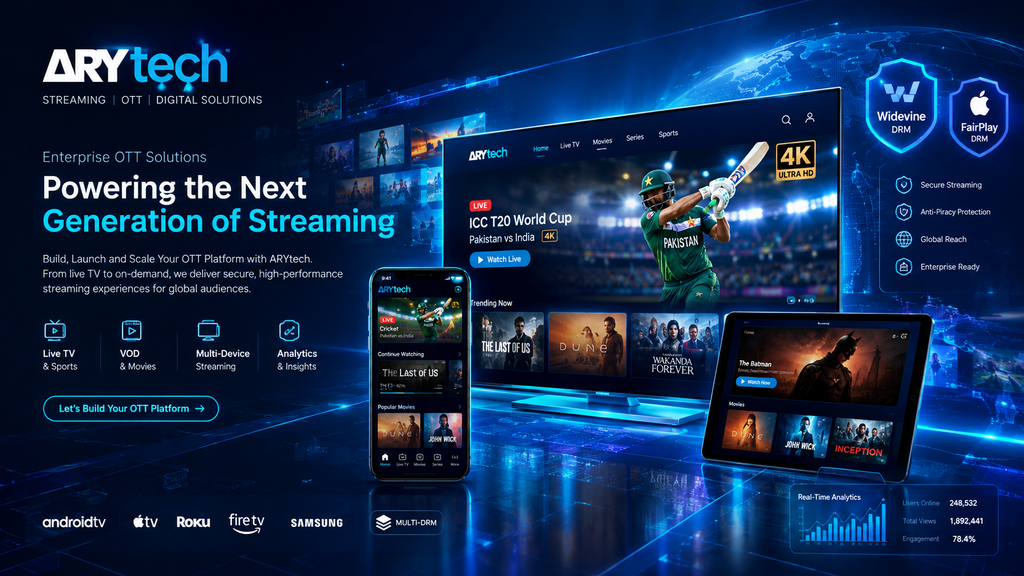
Whether launching new OTT Streaming Services or upgrading an existing backend, choosing a managed platform engine significantly reduces initial development costs and shortens time-to-market.